Everyone is making the same complaint about the trailer for the Moana live action movie.
Disney has dropped the first full trailer for its live-action remake of Moana, and the internet has responded with a remarkable degree of unity — almost entirely negative.
Starring newcomer Catherine Laga’aia in the title role alongside Dwayne ‘The Rock’ Johnson reprising his role as the demigod Maui, the trailer landed on March 23, 2026, and within hours had become one of the most talked-about (and most disliked) trailers of the year.
The complaints are many. But one keeps coming up above all others: it looks completely, drearily, depressingly dull.
The remake nobody asked for
First, some context. The original Moana debuted in November 2016 to widespread critical acclaim and genuine cultural affection.
The story of a Polynesian teenager who sets sail across the ocean to restore the heart of the goddess Te Fiti resonated deeply, not least because of its grounded, respectful portrayal of Pacific Islander culture.
Its soundtrack, written by Lin-Manuel Miranda alongside Mark Mancina and Opetaia Foa’i, produced instant classics, and Auli’i Cravalho’s vocal performance gave the film a heart that lingered long after the credits rolled.
Nearly a decade later, Disney is remaking it. Lin-Manuel Miranda is back as a producer, Johnson is back as Maui, and Cravalho has passed the baton gracefully, returning as an executive producer rather than reprising her role.
In a 2023 Instagram video, she explained her reasoning with characteristic grace: “I’m truly honored to pass this baton to the next young woman of Pacific Island descent, to honor our incredible Pacific peoples’ cultures and communities that helped inspire her story.”
It was a classy exit. The remake, based on its trailer, has struggled to match that energy.
The timing alone raises eyebrows. When Moana hits theaters on July 10, 2026, the original will be barely ten years old — making this one of the shortest turnarounds between an animated film and its live-action remake in Disney history.
An animated sequel, Moana 2, only arrived in late 2024. The rush feels less like creative inspiration and more like a studio mining a franchise while the iron is hot.
“Disney trying to nostalgia bait us with this live action slop when the original isn’t even a decade old,” one viewer wrote on X. “I’ve never seen a creative drought this dire.”
Another was blunter: “You already made a fantastic movie. Moana is nearly perfect. Everything about this looks like a less charming version of the original. I hope it fails miserably so you’ll stop insisting on giving this treatment to animated movies.”
The YouTube comment section has become a particularly rich vein of despair. Among the most liked responses: “What else can I say except, ‘Why did we need this?’”
Another: “I have to admit, I do admire the bravery of Walt Disney Studios of keeping the comment section open.” And perhaps the most cutting of all: “This is diversity! We have a good Moana movie and now a bad one. Thank you, Disney.”
The racism row
Before we get to the complaint — and we will get there — it’s worth addressing the controversy that has run in parallel with the general creative disappointment, because it speaks to something more pointed than mere aesthetic dissatisfaction.
A significant number of viewers have called out what they describe as the whitewashing of the lead character, specifically through the treatment of Catherine Laga’aia’s hair.

In the original animated film, Moana’s hair is thick, gloriously curly, and untamed — an iconic part of her look that Disney actually developed new simulation technology in 2016 to portray accurately.
According to the official Walt Disney Animation Studios website at the time, the film featured characters with long curly hair that presented ‘demanding simulation needs,’ leading to significant changes throughout the hair pipeline.
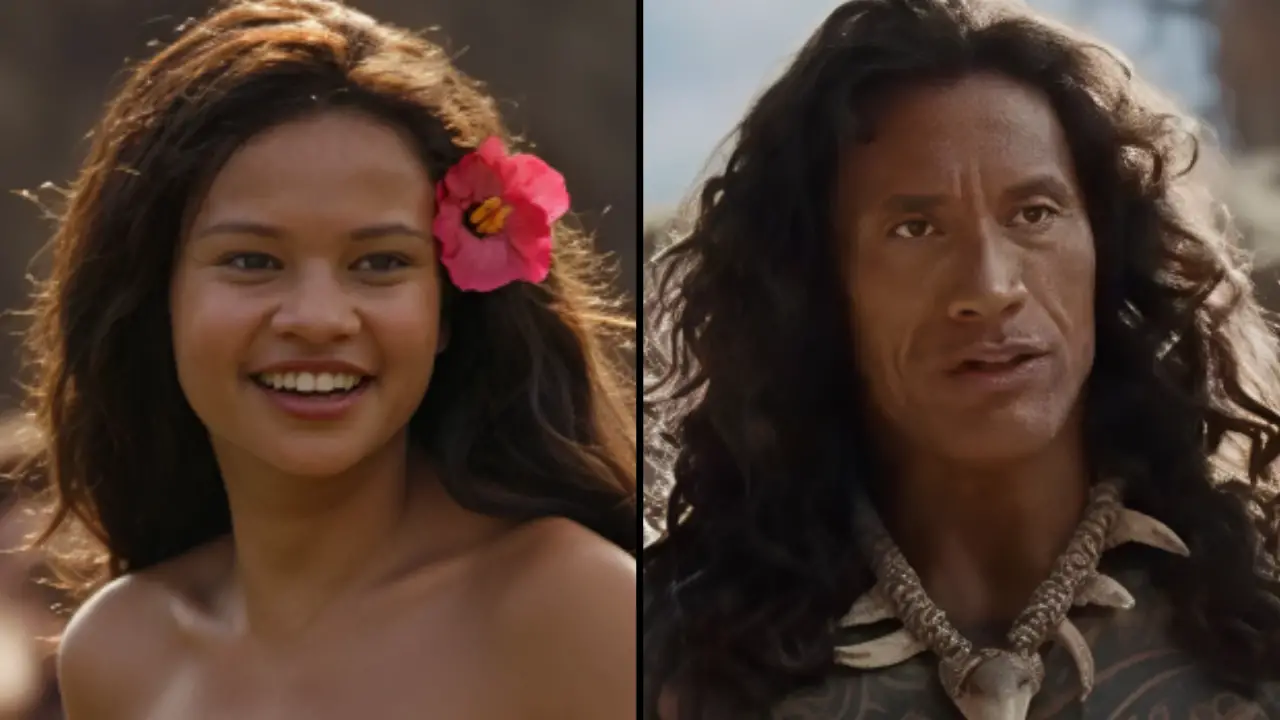
In the live-action trailer, Moana’s hair appears noticeably straighter and flatter. The crucial detail: Laga’aia’s natural hair, visible in off-screen photos including at the 2025 AACTA Awards, closely resembles the animated character’s thick curls. In other words, the production appears to have deliberately straightened it.
“Making her have straight hair even though the OG hair of the actor is just like Moana’s is incredibly f***ing racist,” one person wrote on X.
Another added: “So not only did Disney get an actress who has lighter skin than animated Moana, they also straightened her hair — because I guess they didn’t think they whitewashed her character enough.”
A third put it simply: “This looks awful and they whitewashed Moana.”
The irony cuts deep. Laga’aia, who is 18 and of Samoan descent, has spoken movingly about what the role means to her.
“My grandfather comes from Fa’aala, Palauli, in Savai’i. And my grandmother is from Leulumoega Tuai on the main island of ‘Upolu in Samoa,” she said in an earlier Disney statement. “I’m honored to have an opportunity to celebrate Samoa and all Pacific Island peoples, and to represent young girls who look like me.”
The production’s apparent decision to alter the most visually distinctive element of a character meant to represent Pacific Islander girls, while simultaneously using Laga’aia’s heritage as proof of authentic representation, has not been lost on audiences.

Not everyone agrees, of course. Some have pushed back, with one X user noting that ‘Polynesians have straight hair too,’ and another dismissing critics as ‘woke weirdos slamming Disney just for Moana’s hair being straight.’
But the controversy hasn’t gone away, in part because Disney has a track record here. Princess Tiana from The Princess and the Frog appeared with lighter skin and more Eurocentric features in an earlier Disney crossover, sparking a similar backlash that eventually led to design changes. The pattern has become familiar enough that accusations of whitewashing now arrive almost before trailers finish loading.
This comes shortly after Disney also faced widespread criticism for the live-action remake of Lilo & Stitch, which viewers claimed depicted Hawaiian culture in a reductive and offensive way. The Mouse House appears to be developing a habit.
The main complaint
And now we arrive at what may be the most universally shared complaint — one that cuts across the racism debate, the creative bankruptcy debate, and the cash grab debate, because it’s simply there, visible to anyone with eyes: this film looks utterly drained of color.
The original Moana was a visual feast. Deep blues and greens of the Pacific. The warm gold of island life. The vivid oranges and reds of Te Kā’s molten wrath. Every frame felt alive, soaked in the kind of richness that reminds you why cinema can be such a transport.
The live-action remake, based on its trailer, appears to have siphoned all of that out and replaced it with the flat, grey-tinged aesthetic that has come to define big-budget Hollywood filmmaking in the streaming era.

Critics noted that ‘everything looks artificial, from the over-the-top CGI to the flat, lifeless backdrops,’ raising the genuinely baffling question of how an animated film manages to feel more visually alive than its supposed live-action update.
This isn’t a problem unique to Moana. It is a systemic one. Digital filming saves money and time, especially when scenes need to be reshot — but the downside is significantly less contrast compared to filmstock, meaning modern films can often look flatter and less colorful, per World of Reel.
This has led to many boring-looking movies that all blend into one, with common trends emerging among genres. Lots of action films feature an overwhelming amount of grey, with little saturation given to the characters’ surroundings.
Video essayist Useless Reviews explored what he calls ‘the death of color in cinema,”‘breaking down how Hollywood color grading, digital cinematography, and post-production LUTs have made blockbuster films look dull and lifeless.
He traces the trend back to The Matrix, which used color desaturation to convey a sense of the future — a deliberate, considered choice. From there, the colors dimmed across the industry.
As he put it: “Desaturation isn’t just aesthetic. Sometimes it’s straight up damage control. VFX not finished? Dull the colors. Lighting sucks? Just bury it in darkness.”
He specifically calls out the phenomenon of studios slapping grey LUTs over unfinished effects work as a form of damage control — which, given the Moana trailer’s heavy reliance on obviously unpolished CGI, feels uncomfortably relevant.
For a film set on a lush tropical island in a world of gods, ocean magic, and Polynesian color tradition, the grey flatness of the Moana trailer feels like a particular kind of failure.
“This looks like some bullshit T-Mobile would air during the Super Bowl,” one viewer wrote. Another compared it to AI-generated content — and not favorably. “This looks like the parody AI trailers you find in the depths of YouTube.”
The dislike ratio tells its own story. The earlier teaser currently sits at 53,000 likes against 149,000 dislikes — a 73.8% dislike ratio. The full trailer has done little to reverse that trend.
Disney’s live-action Moana arrives July 10, 2026. Per the critics, it will be visually flat. It will be creatively unadventurous. It will carry the weight of legitimate cultural grievance. And it will almost certainly make a billion dollars anyway, because that’s how this works now.
“Lifeless, soulless trash about to make a billion dollars,” as one X user put it. Bleak — but probably accurate. The golden age of Technicolor feels very far away indeed.
Avatar: Fire And Ash Accused Of Being ‘Racist’ As People Urged To Boycott Movie
People Watching Tim Burton’s The Nightmare Before Christmas Brand It ‘Racist’ And ‘Disturbing’
The post Moana Live Action Slammed By Fans And Critics As Everyone Has The Same Complaint appeared first on It’s Gone Viral.
Tags: #Moana #Live #Action #Slammed #Fans #Critics #Complaint